

Kathmandu: The first thing visitors see when they open the website of Model Institute of Technology (MIT) is the statement: “Best Foreign Affiliated College in Kathmandu.” In other words, MIT claims to be the best among foreign-affiliated colleges operating in Kathmandu.
According to the Ministry of Education, 56 colleges are currently operating in Nepal with affiliations from foreign universities. Of these, 41 are located in the Kathmandu Valley. MIT claims to be the best among these 41 colleges.
The primary criteria for evaluating the quality of a foreign-affiliated college include the Quality Assurance and Accreditation (QAA) status of its affiliated university, the quality of its degrees and their wider recognition. International rankings of universities also indicate their academic standing. In addition, factors such as curriculum advancement and the availability of qualified teachers, experts and professors contribute to determining the quality and reputation of a university and its affiliated colleges.
However, an examination of the available facts suggests that neither MIT College nor its affiliated university, International American University (IAU), stands out in any of these areas. In fact, the evidence raises questions about MIT’s claim to be the “Best Foreign Affiliated College in Kathmandu,” potentially portraying it as one of the weakest foreign-affiliated colleges in the capital instead.
The first reason concerns the standing of the university with which MIT is affiliated and the credibility of the degrees it awards.
According to IAU’s website, the university was established in the United States in 2005. It is a private, for-profit university. This means that its primary institutional objective is generating profit rather than academic advancement.
MIT has consistently presented itself in its promotional materials, website, advertisements and admission process as a college affiliated with International American University (IAU). On this basis, it promises students American-standard education and an American degree. Its slogans and promotional claims create the impression that no other college in Nepal offers an education of comparable quality. However, findings from the investigation suggest that IAU, the university affiliated with MIT, is not among the institutions known for providing high-quality education in the United States.
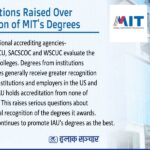
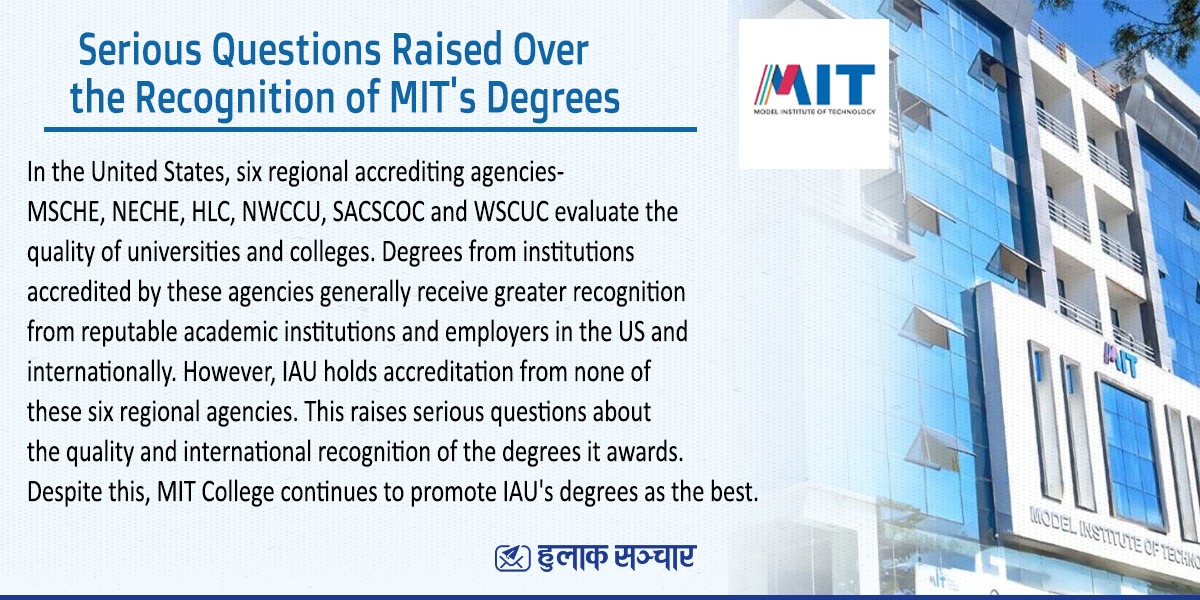
In the United States, six regional accrediting agencies evaluate the quality of universities and colleges: MSCHE, NECHE, HLC, NWCCU, SACSCOC and WSCUC. Degrees from institutions accredited by these agencies generally enjoy wider recognition among reputable American and international academic institutions and employers. However, IAU does not hold regional accreditation from any of these six agencies.
IAU holds accreditation only from the Transnational Association of Christian Colleges and Schools (TRACS), a faith-based accrediting body that incorporates religious educational principles and is generally considered to have a more limited scope than regional accrediting agencies. TRACS is recognized by the U.S. Department of Education (USDE) and the Council for Higher Education Accreditation (CHEA). However, its accreditation is not considered as broad in scope as regional accreditation.
Accreditation from organizations such as TRACS is often associated with smaller religious institutions and institutions offering specialized academic programs. Degrees from such institutions may not always receive straightforward recognition for postgraduate admissions at major universities or for employment opportunities in the global job market. This raises significant questions about the recognition and international acceptance of degrees awarded by IAU.
IAU has also received authorization to operate from California’s Bureau for Private Postsecondary Education (BPPE). BPPE grants private educational institutions legal permission to operate and oversees whether they comply with the regulations governing their establishment and operations. However, this authorization is not proof of academic quality.
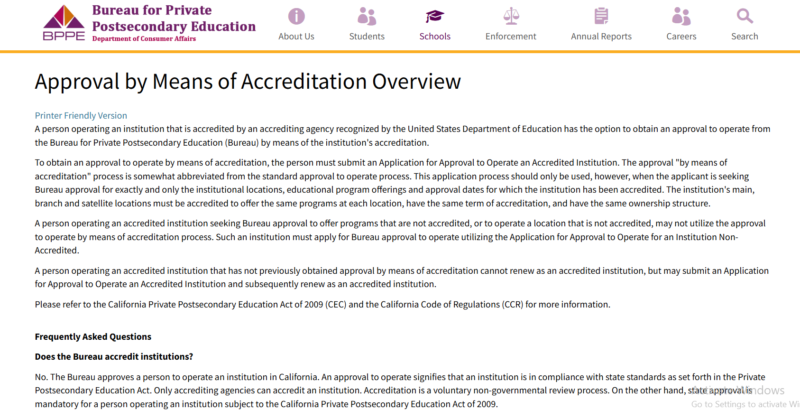
BPPE has clearly stated on its website that authorization to operate does not mean an institution’s academic programs have been certified as being of high quality. In other words, although IAU may attempt to present itself as a prestigious institution by highlighting its BPPE authorization, this is comparable to obtaining legal registration to open a business. It does not guarantee the quality of the education being offered.
Institutions of this nature may be established with commercial objectives and a greater emphasis on generating profits than providing high-quality education. Students are attracted through expensive promotional campaigns, appealing advertisements, and attractive slogans. However, they may later find themselves disappointed when their degrees do not receive the recognition they had expected.
Second, there is no clear basis for placing the university among leading American research universities or internationally established and prestigious academic institutions.
Holding TRACS accreditation and being a world-class university are two entirely different things. TRACS accreditation indicates that an institution has met certain institutional standards. However, it does not place the university among the world’s leading academic institutions.
Similarly, assuming that a university has a strong international reputation simply because its name includes words such as “International” and “American” would be misleading. This is precisely where MIT appears to exploit young students who approach the college seeking educational opportunities, but lack proper awareness.
MIT has attracted students with promotional slogans such as “American Degree in Nepal,” “Best Foreign Affiliated in Kathmandu,” “Seamless Credit Transfer to USA,” and “Study in Nepal, Graduate from USA.”
Whether it is an orientation session or another college event, MIT invites well-known singers, musicians and artists. The college has installed billboards and digital advertisements at major entry points into Kathmandu, extending its promotional presence to the domestic terminal of Tribhuvan International Airport. It has even managed to establish a partnership with a team participating in the highly popular Nepal Premier League (NPL).
These seemingly smart promotional slogans and campaigns can easily influence students and parents searching for a suitable college. In recent years, pursuing higher education abroad after completing Plus Two, bachelor’s or master’s degrees in Nepal has become increasingly common.
There is also a widespread perception among students that obtaining a foreign degree from a college in Nepal may give them an advantage in visa applications and make it easier to secure employment after moving abroad.
Naturally, such promises and perceptions can strongly influence young students, whose decisions are often shaped by the aspirations and expectations associated with studying abroad.
One student who fell into this trap shared their experience and told,“I failed to understand in time that a college’s quality should not be judged by how aggressively it promotes itself, but rather by the university it is affiliated with and the credibility of the degree it offers. It is extremely important to investigate these aspects before enrolling. When I was applying for admission, I was impressed by the college’s external image and promotional activities and assumed that it really was the best college in Kathmandu. However, as I began to understand the facts, I realized the reality that MIT is the worst college in Kathmandu.”